

 English
  Tiếng Việt
 A few years ago, wandering the streets of San Francisco (California, USA), I saw the stores of several mobile carriers advertising impressively and eye-catchingly: 4G is here or 4G is coming. And a few months ago, I traveled all over the United States with T-Mobile's 4G service, which covered almost everywhere I went. Wherever I went, I posted hot pictures and videos to Facebook and my websites. The data transmission speed of the 4G network was incredibly fast.
I asked friends in the US who used 3G before, how they felt about upgrading to 4G? Everyone loved its speed and bandwidth. So, those who have used 3G at full speed and were convinced by 4G, how much more 'bewildered' would one be who has endured the 'crawling' 3G network (3G with tortoise-like speed)?
4G speed test results in some countries around the world
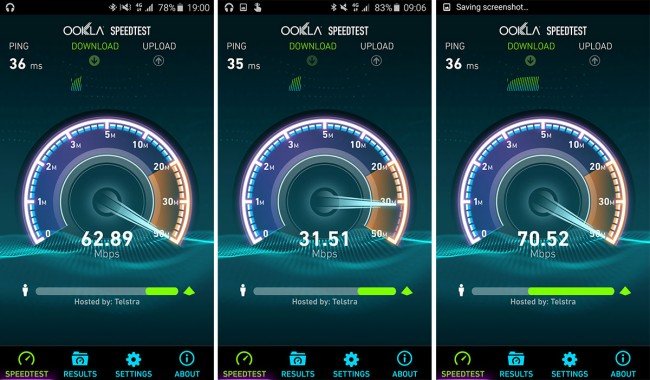
The speed of Telstra's (Australia) 4G LTE network, benchmarked by the Galaxy S6, is quite impressive. Data according to GadgetGuy's test in April 2015.
>>>To best experience 4G speed, you should use: 4G wifi hotspot device
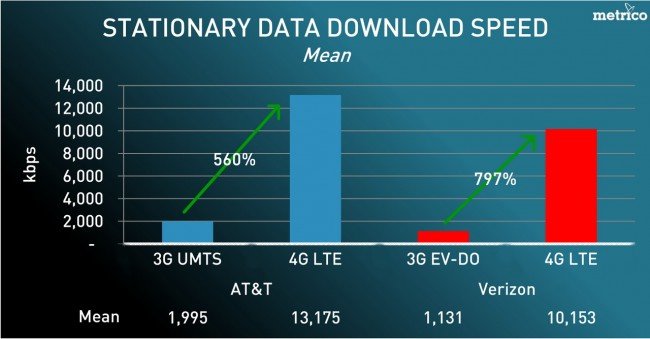
The lowest download speed of the 4G LTE network in the US, tested by Bionic in December 2011, was also very fast.
Of course, the most outstanding feature that users look forward to and carriers use for advertising is the speed of the 4G mobile network.
3G and 4G are both acronyms for the third generation (third generation) and fourth generation (fourth generation) of mobile communication technology.
After 15 years of developing specifications and standards, the world's first 3G network was introduced in Japan in 1998 by NTT DoCoMo and only commercialized in 2001. According to data from the International Telecommunication Union (ITU), at the end of 2012, there were 2 billion 3G subscribers worldwide out of a total of 6.8 billion mobile subscribers (accounting for about 30%). In Vietnam, according to the General Statistics Office, as of June 2015, there were 29.1 million 3G subscribers nationwide out of a total of 136.9 million mobile subscribers.
With data transmission speeds many times faster than 2G (maximum speed only 40-50kbps), 3G is called a mobile broadband network. The initial speed of 3G was internationally defined as a minimum of 200kbps (0.2Mbps).
Later, with the development to 3.5G and 3.75G networks, the speed increased. The IMT-2000 standard specifies a minimum data transmission speed of 2Mbps when the user is standing or walking and 384kbps when the vehicle is moving.
The maximum speed of 3G depends on the capabilities and technology of each carrier. For example, in India, 3G has a minimum speed of 2Mbps and a maximum of up to 28Mbps. The highest is HSPA+ technology (also known as 3.75G) with a theoretical maximum speed of 168Mbps (downlink) and 22 Mbps (uplink). In Vietnam, according to field measurements in Hanoi by Viettel network, 90% of samples achieved speeds above 512kbps or 1Mbps.
Meanwhile, 4G technology (first introduced in South Korea in 2007) has now evolved to the LTE (Long Term Evolution) version and most recently LTE-A (Long Term Evolution Advanced) with a maximum speed defined by the ITU of up to 100Mbps when the vehicle is moving and 1Gbps when walking or standing still. The maximum speed of LTE is 100Mbps (download) and 50Mbps (upload). As for LTE-A, it is 1Gbps (download) and 500Mbps (upload).
Reasons why 4G needs to be present at the current time
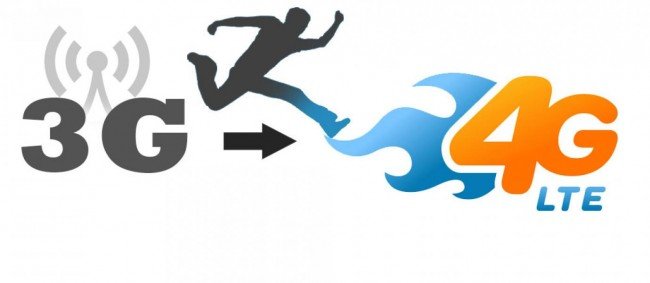
Just looking at the data transmission speed comparison table between 3G and 4G, one can understand why the whole world is eagerly transitioning from 3G to 4G.
During a meeting with journalists in Ho Chi Minh City, Mr. Thieu Phuong Nam, General Director of Qualcomm Vietnam and Indochina, explained the difference between mobile network generations: 2G for voice, 3G for data, and 4G for digital content on the network. Additionally, 4G has significantly higher safety and security standards, which is essential in an environment with so many risks and uncertainties online.
Currently, smartphones are becoming increasingly popular in society with ever-cheaper prices. They allow users to connect to the Internet for information and entertainment, and even work. Mobile users are trending towards attending social networks, sharing photos and videos they record with their smartphones with others. Online games are also developing strongly on mobile platforms. Television and movie streaming channels are also thriving on mobile networks. Even websites are integrating multimedia. Especially now, people prefer high-quality audio-visual content, with resolutions not only Full HD but also up to Ultra HD 2K, 3K.
All of these depend on the data transmission speed of the mobile network. Even the 3G network, even running at its highest speed, can no longer cope.
4G Việt Nam cần làm thật tốt
Ngay từ năm 2010, bộ quản lý viễn thông ở Việt Nam đã cho phép các mạng VNPT, Viettel, FPT Telecom, CMC và VTC tiến hành thí điểm mạng 4G trong vòng 1 năm. Và từ cuối năm 2015, Bộ thông tin và Truyền thông bắt đầu cấp phép cho những nhà mạng có đề nghị được chính thức thử nghiệm và cung cấp dịch vụ 4G. hiện giờ, có các nhà mạng Viettel, VNPT (Vinaphone) và MobiFone đã xin thí nghiệm 4G. Năm 2016, mạng 4G sẽ bắt đầu được phủ sóng ở Việt Nam.
Ông Thiều Phương Nam, một trong những người bấy lâu hăng hái vận động ứng dụng 4G ở Việt Nam, cho rằng năm 2016 chính là thời điểm thích hợp nhất để phủ sóng 4G ở Việt Nam. Công nghệ này đã chín muồi và đã được áp dụng thực tế ở ngày càng nhiều nước trên thế giới. Thiết bị hạ tầng ngày một rẻ. Số lượng thiết bị di động hỗ trợ 4G đang ngày càng nhiều hơn và bắt đầu được mở rộng tới phân khúc phổ biến.
Trong thời kì qua, các nhà mạng di động cung cấp 4G đang hăng hái lắp đặt các trạm truyền phát sóng BTS cho 4G (không dùng được hạ tầng cũ). Để sử dụng 4G, thuê bao Vinaphone có thể dùng SIM 3G đang có, trong khi Viettel đề nghị phải đổi SIM mới. Các nhà mạng cho biết giá cước 3G với 4G giống nhau, vì với 2 chuẩn này, cước được tính trên dung lượng dữ liệu truyền tải. bởi vậy dùng 4G với tốc độ cao, người dùng có lợi là tốn ít thời gian hơn và nhà mạng ít bị chiếm dụng băng thông hơn.
Từ kinh nghiệm của 3G, kiên cố các nhà mạng sáng dạ biết nhìn xa trông rộng sẽ đầu tư lên ngay đời 4G LTE-A với tốc độ cao nhất. Và hy vọng một khi phủ sóng 4G, mạng 3G sẽ giảm tải, thông thoáng hơn, cải thiện được tốc độ phục vụ tốt hơn cho những thiết bị chỉ hỗ trợ 3G. Đó gọi là chơi 4G mà 3G được hưởng lợi.